

PURE WATER PROTECT
Cleaner hulls. Less aggressive chemistry. More manageable maintenance.
Ultra-thin easy-to-clean surface technology for marine applications — developed to reduce adhesion and cleaning effort on defined underwater surfaces without relying on a conventional biocidal approach.
THE CHALLENGE
Underwater, the surface influences maintenance, fouling and operation.
Conventional underwater care can involve repeated cleaning, material removal and chemical use. PURE WATER PROTECT follows another system logic: a smooth, maintainable functional surface.
SALTWATER & MARINE EXPOSURE
CLEANING & SURFACE WEAR
OPERATION & DOWNTIME
EASY-TO-CLEAN TECHNOLOGY
Not biocidal action. Surface function.
SUBSTRATE
Defined existing marine substrate.
PREPARATION
Assess cleaning, condition, old coating and roughness.
PURE WATER PROTECT
Thin functional surface layer.
EASY-TO-CLEAN EFFECT
Adhesion is intended to be reduced and cleaning facilitated.
The technology is not designed to chemically attack fouling. It changes the conditions at the surface.
DOCUMENTED PERFORMANCE BASIS
Practice is a starting point. A season creates the project record.
70–90 m²/LDocumented surface / water-area logic.
>200 BOATSPractical basis according to available project documents.
BIOCIDE-FREEDocumented / positioned product logic.
EVIDENCE
Practice is a starting point. A season creates the project record.
Existing documentation basis; declaration requires further support.
Documented product / application basis; measure object consumption additionally.
Practice figure from documents; build a structured reference list.
Practice / plausible application experience; seasonal comparison required.
Technically plausible smoothing logic; measurement programme required.
REAL-WORLD VALIDATION
The decisive test is a season in the water.
HULL CONDITION
Material, old coating, roughness and fouling level.
TEST ZONE
Defined starboard / port or hull zones.
APPLICATION
Layer, consumption, drying and water-entry timing.
MONITORING
Fouling, photographs, cleaning effort and cleaning agent; optionally speed / consumption.
SEASON REPORT
Result for owner, yard, marina and project file.
A documented seasonal comparison is more informative than a single marketing image.
Marine surfaces need a zone logic.
Marine surfaces need a zone logic.
SPORTS BOATSYACHTSCHARTER FLEETSMARINAS / SERVICEDEFINED UNDERWATER SURFACES
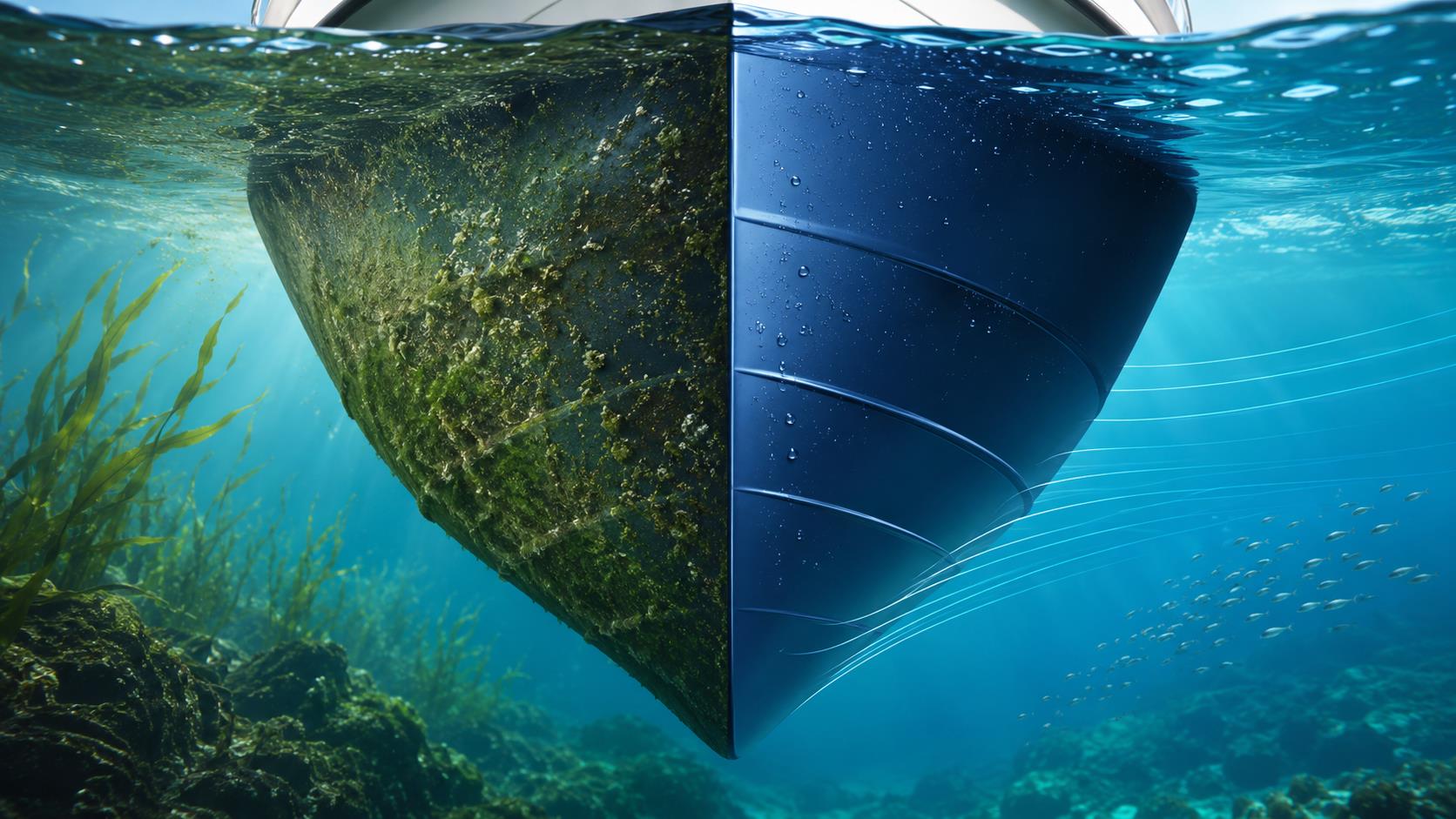
Practical observation on marine surfaces
The webcut shows deposits and marine growth on hull and drive areas, water-jet and brush cleaning, and a final treated-versus-untreated surface comparison. It does not show the coating application.
B · practical application documentation
What you see
- deposits and marine growth
- water-jet cleaning
- manual brush cleaning
- treated-versus-untreated comparison
MARINE RESPONSIBILITY
Less chemistry is a goal. Not an unsupported environmental promise.
- biocide-free positioning
- low material use
- potentially gentler cleaning
- longer maintenance intervals as a development / practice goal
- documentable application
OPEN EVIDENCE FIELDS
- eluate
- abrasion
- microplastics
- aquatic organisms
- finished complete system
HYDRODYNAMICS
A smoother surface can be hydrodynamically relevant.
This is a technically plausible development and measurement hypothesis, not a universal fuel-saving claim.
- defined boat type
- speed
- load
- weather
- fouling
- consumption
- comparison period
APPLICATION & QA
Marine performance starts with documented application.
- Assess hull condition
- Define test zone
- Prepare substrate
- Document consumption
- Document drying
- Document water-entry timing
- Season monitoring
- Care protocol
- Final report
REGULATORY / MARKET ACCESS
Underwater applications need clear environmental and harbour logic.
ANTIFOULING BOUNDARY
Separate easy-to-clean / biocide-free positioning clearly from active-substance systems.
HARBOUR / YARD
Observe local rules for cleaning, abrasion and wastewater.
ECOTOXICOLOGY
Structure eluate, abrasion, microplastic and aquatic-organism evidence.
CLAIMS
No general antifouling claim without comparison and long-term data.
RESPONSIBLE CLAIMS
What is documented — and what is not generally derived.
DOCUMENTED / AVAILABLE BASIS
- biocide-free positioning
- 70–90 m²/L according to documents
- practice basis >200 boats according to documents
- marine easy-to-clean logic
- definable test zones
- season monitoring
NOT GENERALLY DERIVABLE
- fouling-free performance
- universal antifouling replacement
- guaranteed fuel saving
- fixed lifetime for every application
- universal substrate release
- environmental harmlessness
- no impact on aquatic organisms
- universal harbour approval
LIFECYCLE VALUE
Economics develop across the care cycle.
cleaning intervalscleaning timematerial consumptionservice periodssurface carepotential hydrodynamic effectseasonal usability
How does PURE WATER PROTECT behave on your hull over a season?
We define substrate, test zone, application and monitoring together to create a robust project basis.